
Close



Watch for 4 signs: repeated trips, a shuffling walk, avoiding stairs, and asking for help with small jobs. Then try the 30-second chair test at home. If your parent scores low, strength and balance training can help, even in their 80s and 90s.[12][14]
"My dad keeps tripping." "Mum won't go anywhere with stairs." We hear this from sons and daughters all the time.
Many families put it down to old age. More often, it's a sign of weak leg muscles. And muscles can get stronger at any age.
Strength fades faster than most people think. In one study of people in their 70s, leg strength dropped about 3% every year.[3]
Weak legs lead to falls. More than 1 in 4 older people fall each year, and falling once doubles the chance of falling again.[1] In Malaysia, about 1 in 6 older people fall each year.[2]
They shuffle or drag their feet. Normally, the toes lift up with every step. When the toes don't lift, the foot catches the floor more easily.
They skip places because of one flight of stairs, or keep complaining about steps and curbs.
"Can you move this small shelf for me?" "Can you carry this flower pot?" Little jobs start to feel too hard.
Anyone can fall once. The warning sign is a pattern: tripping often, losing balance, or holding onto furniture to walk around the house. The CDC lists holding onto furniture as a fall-risk sign.[5]
Watch your parent walk across a room. Do they shuffle? Do their feet drag? Does the front of the foot lift up with each step?
The muscles on the front of the shin lift the toes as you walk. When they get weak, the foot can catch the floor. Research links foot drag and uneven steps to more trips in older adults.[6]
Walking speed matters too. In older adults, a slower walk is linked to a shorter life.[7]
This one is easy to miss. A healthy older person doesn't think twice about a flight of stairs. Someone losing muscle will skip a place just because of one flight.
Doctors use a short checklist for muscle loss called SARC-F. One of its 5 questions is how hard it is to climb 10 steps.[8] The CDC also lists trouble stepping up onto a curb as a sign of weak legs.[5]
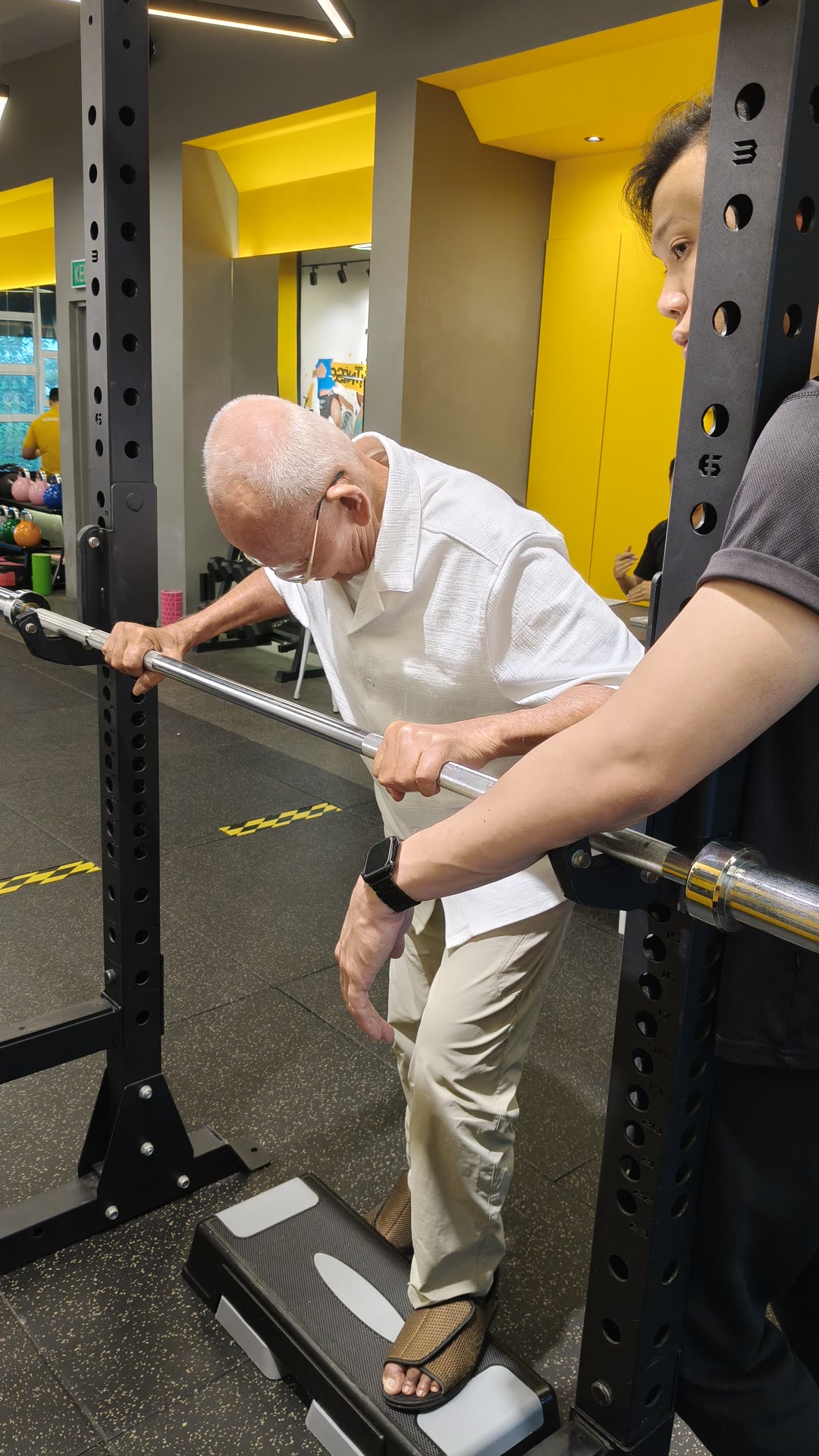
Watch for small requests. "Can you move this shelf?" "Can you lift this pot?" Many people think this is just part of getting old.
It doesn't have to be. We train clients in their 60s and 70s who still lift a fair amount. They move a lot like younger people, and they rarely need help. They can do about 9 out of 10 things a younger person can. That should be normal.
SARC-F also asks how hard it is to lift and carry about 4.5 kg.[8] And fear matters. Older adults who fear falling often do less, and doing less makes them weaker.[9][1]
Weak legs are the biggest clue. The easiest way to check leg strength at home is the 30-second chair stand. It's the first fitness test we use with new clients at iLift.[10]
Stand close by. If they have to push with their arms to get up, stop the test. That counts as 0.[10]

| Age | Men: normal | Men: low | Women: normal | Women: low |
|---|---|---|---|---|
| 60 to 64 | 14 to 19 | below 14 | 12 to 17 | below 12 |
| 65 to 69 | 12 to 18 | below 12 | 11 to 16 | below 11 |
| 70 to 74 | 12 to 17 | below 12 | 10 to 15 | below 10 |
| 75 to 79 | 11 to 17 | below 11 | 10 to 15 | below 10 |
| 80 to 84 | 10 to 15 | below 10 | 9 to 14 | below 9 |
| 85 to 89 | 8 to 14 | below 8 | 8 to 13 | below 8 |
| 90 to 94 | 7 to 12 | below 7 | 4 to 11 | below 4 |
Number of full stands in 30 seconds. "Normal" is the middle half of scores for that age. A "low" score is below average and is a sign of fall risk.[10][11]
At any age, fewer than 8 stands without using the arms is linked to more trouble with daily tasks.[11]
See a doctor first if there was a recent fall with an injury, or new dizziness or weakness.[16] If they hit their head, hurt their hip, or can't get up after a fall, get help straight away.[16]
Exercise works. A large Cochrane review found exercise cut falls by 23%. Programs that mix balance and strength work cut falls by about 34%.[12]
The WHO says older adults should do muscle-strengthening on 2 or more days a week. They should also do balance and strength activities on 3 or more days a week.[15]
In one famous study, nursing home residents aged around 90 got 174% stronger in just 8 weeks.[13] In another, people aged 72 to 98 more than doubled their strength and climbed stairs with more power.[14] You can read more in Is it ever too late to start lifting weights after 60?
Write down the score. Do the chair test again every 2 to 3 months. A rising number is the easiest way to see progress. It also gives your parent a real win.
Gracie had two falls in one year. That was her wake-up call. A year later she's stronger and steadier, and she even helped move house. Read Gracie's story.
Judith came to us at 80, full of doubt, because her children encouraged her. Now she squats, gets up from her chair and moves steadily. Read Judith's story, or see all our client stories.
Some muscle loss comes with age. But a fast drop in strength, more trips, or new trouble with stairs is a warning sign. Strength can be built back at any age.
For ages 70 to 74, the normal range is 12 to 17 stands for men and 10 to 15 for women. Below 12 for men or 10 for women is below average.
Yes. In one study, people aged 72 to 98 more than doubled their leg strength in 10 weeks of strength training.
The WHO says muscle-strengthening on 2 or more days a week, plus balance and strength activities on 3 or more days a week to help prevent falls.
This article is general information, not medical advice. If there has been a recent fall with injury, or a doctor has said not to exercise, speak to them first.
A relaxed chat about their health, their worries and what they want to keep doing. No pressure, and you are welcome to come along.
Book a Free Consultation → Optimized by Seraphinite Accelerator