Close


See a physiotherapist first if you had surgery in the last 6 months or a recent stroke. Do the same if you can't stand up from a chair, grip things, or walk steadily on your own. Once you're back to about 70% of your normal, a qualified personal trainer can take you further. Physios get you well. Trainers help you thrive.
"Should I see a physio or a trainer for my knee?" We get asked this a lot. Both can help you move better. But they have different jobs.
A physiotherapist assesses, diagnoses and treats movement problems after an injury, illness or surgery.[1][2] Their goal is to get you back to baseline. That means back to your normal, everyday life.
In Malaysia, physiotherapists are registered health professionals under the Allied Health Professions Act 2016. You can book one yourself, without a doctor's referral.[3]
A good personal trainer's goal is to take you beyond baseline. We build extra strength, like a cushion. Daily life feels easier, and you're less likely to get hurt again.
Trainers don't diagnose or treat injuries.[4] There is also no government licence for personal trainers in Malaysia.[5] So check that your trainer has real qualifications, and real experience with people like you.
Physios help you get well. Personal trainers help you thrive.
| Physiotherapist | Personal trainer | |
|---|---|---|
| Main goal | Get you back to normal | Get you stronger than normal |
| Best for | After surgery, injury or stroke, when daily life is hard | When daily life is okay, and you want more strength and less risk |
| Diagnoses and treats | Yes | No. Works around problems and refers you on |
| In Malaysia | Registered by law. You can book one yourself | No government licence. Check their training and experience |
A quick comparison. Sources: World Physiotherapy, NHS, ACE.[1][2][3][4]
These are our own studio rules, from years of working with older adults. They are a guide, not an official medical checklist.
Some things need a doctor straight away. Get help if you fell and hurt your head, back or hip, or can't get up.[13] Numbness or weakness in both legs, or new trouble with your bladder or bowels, also needs urgent care.[14]
Here's an example. Say you fell, needed surgery, and can now do about 70% of what you did before the fall. That's when we can help. You don't need to be 100% first.
Being "back to normal" and being strong are not the same thing.
After a knee replacement, most people are back to daily activities in 3 to 6 weeks.[6] But full recovery can take several months or longer.[7] One month after surgery, thigh strength was 62% lower in one study.[8]
Many people also stop their exercises once physio ends. In one study of older adults, 37% had stopped their home exercises.[9] And strength fades fast when you stop. A year after they stopped training, one group of older women had lost 68% of their strength gains.[10]
That's why the cushion matters. Older adults with more strength in reserve have less trouble with daily tasks like washing, dressing and shopping.[11]
Between about 70% and 100% of normal, a physio and a trainer can both help. This is the middle part of the drawing above.
Physio bodies support this. The UK's Chartered Society of Physiotherapy says exercise professionals can work well alongside physios.[12] If you're still seeing a physio, tell us. We're happy to follow their advice.
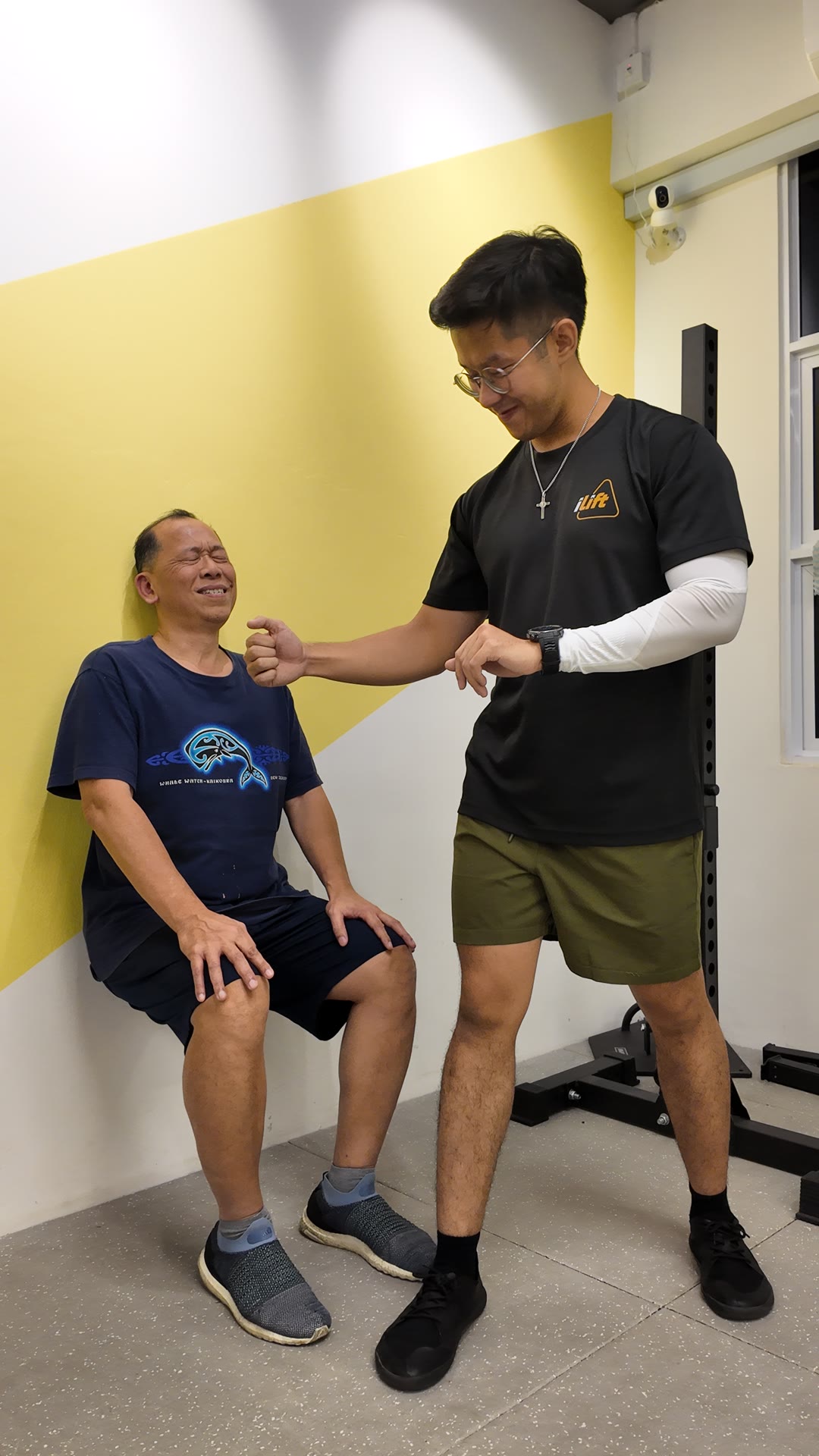
Jonathan was facing knee surgery when he started training with us. A year on, he didn't need the operation. You can see him doing a wall sit with his coach at the top of this page. Read Jonathan's story.
You can book a physio yourself. Kuching has physiotherapy at the main public hospital and at private medical centres. If you're unsure, ask your doctor which one suits you.
You can also come in for a free chat with us. We'll ask what happened and watch how you move. If a physio is the better first step, we'll tell you.
No. In Malaysia, you can book a physiotherapist yourself. You do not need a doctor’s referral.
No. Personal trainers do not diagnose or treat injuries. A good trainer works around your injury and sends you to a doctor or physio when needed.
Most people are back to daily activities in 3 to 6 weeks, but full recovery can take several months or longer. At iLift, we usually start once you are about 6 months past surgery, or when your surgeon or physio says you are ready.
Yes, as long as each one knows about the other. Physios and exercise professionals often work well together.
This article is general information, not medical advice. If there has been a recent fall with injury, or a doctor has said not to exercise, speak to them first.
Tell us what happened and how you move today. If a physio is the better first step, we will tell you honestly.
Book a Free Consultation → Optimized by Seraphinite Accelerator